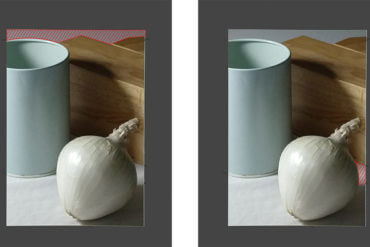
Over the past few weeks we've explored nearly all of the layer blending modes found in GIMP and Photoshop, so in today's article I'll be finishing up the series by demonstrating the final four: Hue, Saturation, Color and Value.. . . read more
Have you ever been caught off-guard by a visual tangent in your art? When creating a composition there are so many different things to juggle that it's easy to miss even the obvious flaws - and that’s when tangents sneak in.. . . read more
So many blending modes, so little time. . . Up until now we've looked at the more common blending modes, but in today's article we'll be examining these five: Difference, Addition, Subtraction, Darken, and Lighten.. . . read more
Does every painting need a focal point? Some artists would say no, while others consider them an absolute requirement. But what is a focal point? And why do we use them in our paintings in the first place?. . . read more
Last week I demonstrated several blending modes used in GIMP and Photoshop, such as Multiply, Divide, Overlay, and Screen. Today I'll be exploring four more: Dodge, Burn, Hard Light and Soft Light plus a few bonus modes found only in GIMP.. . . read more
In normal life we hardly ever notice the light source’s temperature - but as artists, we should always understand the temperature of the light, since it controls the color of everything else we see.. . . read more
Blending modes are a great way to change the effects of layers in Photoshop or GIMP - as long as you know how they work. This easy-to-understand tutorial explains some of the more common blending modes.. . . read more
Have you heard of alternation? A rarely discussed design tool, alternation can sometimes be the very method you need for moving the viewer’s eye through your painting, or making dull areas interesting.. . . read more
In my last GIMP tutorial I showed you how to make a sepia-tone photo from a color photo. Today we're going to do something similar - follow along to learn how to digitally color (or hand-tint) a black and white photo in GIMP.. . . read more
Most of us realize that if we put too much visual information into a single work of art all at once, our viewers won't know where to look. But just as a musical composer guides what his audience hears, a painter can guide his viewers' eyes. . . . . . read more